SPR: examples explained
Maturity and boundaries: experimental
Implemented scope: The existing command set plus 73 selected new roots and selected bitmap, queue, process, registry and Windows helpers are documented.
Boundary: 60 roots remain unfinished; there is no MiniRobot comparison qualification, SAP and SPR Browser are deferred, and many selectors/providers remain open.
SPR supported command roots and scope
Browse the language-specific supported-command and scope reference, with searchable categories and explicit boundaries.
Open scope referenceSPR uses short command prefixes and variables such as $$SUM. These native examples combine explicit values, calculations and output.
Twelve short examples and one larger program. Choose a topic or work through the examples in order.
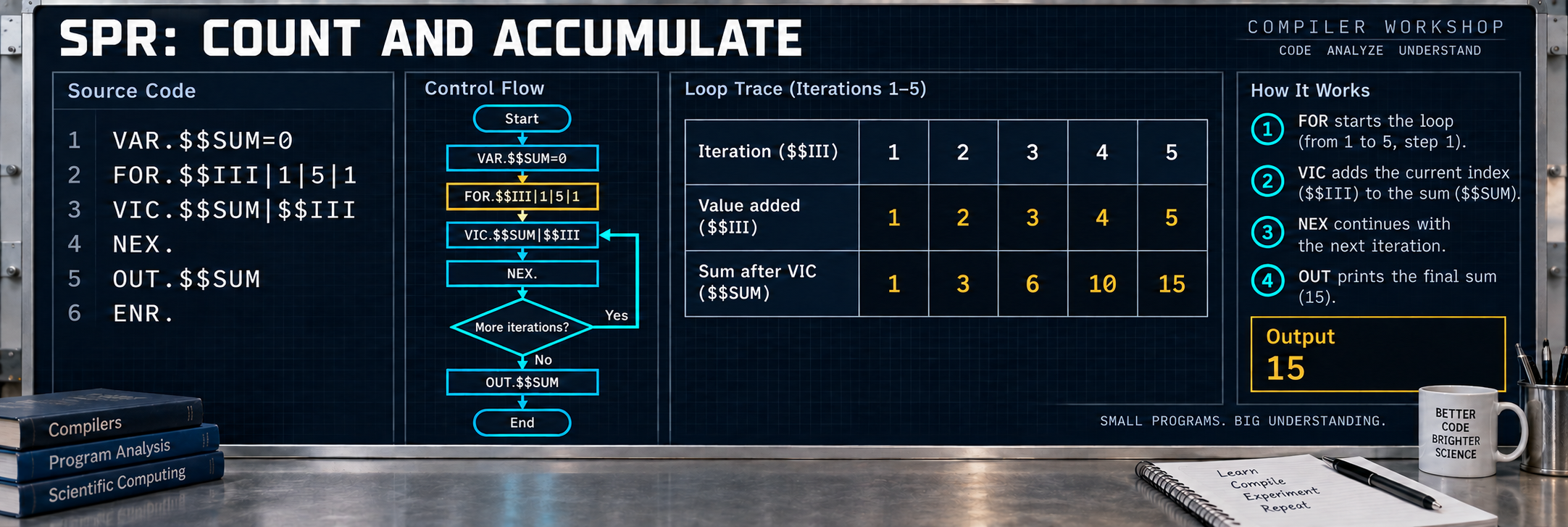
1. 1 + 2 + 3 + 4 + 5 = 15
The numbers 1 through 5 are added to 15. The program prints 15 and ends with exit code 0.
VAR.$$SUM=0
FOR.$$III|1|5|1
    VIC.$$SUM|$$III
NEX.
OUT.$$SUM
ENR.
Expected exit code: 0; output verification pattern (regex): '15'
PBXB64.exe sum15-spr.spr -O2 -o example.exe
.\example.exe
$LASTEXITCODE
Executed natively with the V22 candidate from 2026-09-30; final-compiler verification pending.
2. Arithmetic with CAL. and CAX.
VAR. sets up 1 and 2. CAL. calculates 1 + 2 * 3 as 7; CAX. uses sqrt(16). This case has no explicit output and checks successful program completion.
' Minimal SPR math-coverage fixture.
VAR.$$AAA=1
VAR.$$BBB=2
CAL.$$CCC=$$AAA+$$BBB*3
CAX.$$DDD=sqrt(16)
END.
Expected exit code: 0
PBXB64.exe math.spr -O2 -o example.exe
.\example.exe
$LASTEXITCODE
Canonical test case with an expected result; no new native V22 check here. Final execution pending.
3. Extend and print a string value
VAR. creates the text, VAS. extends it and OUT. prints the variable. Exact composition follows the SPR command contract; the canonical output test expects helloworld.
' SPR string-coverage fixture.
VAR.$$MSG=hello
VAS.$$MSG+ world
VAU.$$INP=test
OUT.$$MSG
END.
Expected exit code: 0; output verification pattern (regex): 'helloworld'
PBXB64.exe strings.spr -O2 -o example.exe
.\example.exe
$LASTEXITCODE
Canonical test case with an expected result; no new native V22 check here. Final execution pending.
4. FOR and a post-test loop
Step-by-step flow
- VAR. creates SUM; FOR. and NEX. form a counted loop over 1 through 5.
- The body updates SUM using the existing VAR. command contract.
- DOL./OOP. then demonstrates a post-test. The canonical case expects completion without explicit console output.
' SPR loop fixture
VAR.$$SUM=0
FOR.$$CTR|1|5
VAR.$$SUM=$$SUM+$$CTR
NEX.
DOL.
OOP.$$SUM>10
END.
Expected exit code: 0
PBXB64.exe spr-loop.spr -O2 -o example.exe
.\example.exe
$LASTEXITCODE
Expected-result contract from tests/validate.toml. This website expansion adds no new native compiler verification. Execution with the qualified final compiler remains pending.
5. A subroutine with one argument
Step-by-step flow
- GSB. with target :add5 and argument 10 passes a value to the subroutine.
- The body uses legacy argument alias $$000 in its assignment and returns with RET.
- JMP.:done prevents normal flow from entering the body again. This case checks completion rather than a printed numeric result.
' SPR subroutine fixture
VAR.$$AAA=0
GSB.:add5|10
JMP.:done
:add5
VAR.$$AAA=$$000+5
RET.
:done
END.
Expected exit code: 0
PBXB64.exe spr-subroutine.spr -O2 -o example.exe
.\example.exe
$LASTEXITCODE
Expected-result contract from tests/validate.toml. This website expansion adds no new native compiler verification. Execution with the qualified final compiler remains pending.
6. Subroutine argument count and values
Step-by-step flow
- GSB. supplies two arguments, 42 and hello.
- $$_00 denotes argument count 2 in this documented contract.
- $$_01 and $$_02 contain the two arguments. PRT. therefore prints 2, 42 and hello.
' SPR reference contract: documented subroutine parameter aliases.
GSB.:SHOW|42|hello
END.

:SHOW
PRT.$$_00
PRT.$$_01
PRT.$$_02
RET.
Expected exit code: 0
Canonical output verification pattern (regex)
2
42
hello
PBXB64.exe spr-spr_subroutine_documented_params.spr -O2 -o example.exe
.\example.exe
$LASTEXITCODE
Expected-result contract from tests/validate.toml. This website expansion adds no new native compiler verification. Execution with the qualified final compiler remains pending.
7. Branch on a collection entry
Step-by-step flow
- ATC. stores alpha in collection 7.
- JNU. branches to seen when alpha is present.
- OUT.bad is skipped; the reached output command writes seen.
ATC.7|alpha
JNU.7|alpha|seen
OUT.bad
END.
:seen
OUT.seen
END.
END.
Expected exit code: 0
Canonical output verification pattern (regex)
^seen\n$
PBXB64.exe spr-spr_reference_collection.spr -O2 -o example.exe
.\example.exe
$LASTEXITCODE
Expected-result contract from tests/validate.toml. This website expansion adds no new native compiler verification. Execution with the qualified final compiler remains pending.
8. Enumerate collection elements with FEC.
Step-by-step flow
- CLC. clears collection 9; ATA. adds alpha and beta.
- FEC. and FEN. surround iteration; $$ITM holds the current element.
- OUT. displays both texts in the concrete test contract's order, separated by whitespace.
' Source-backed FEC collection enumerator contract.
VAR.$$OUT=
CLC.9
ATA.9|alpha
ATA.9|beta
FEC.LAB|$$ITM|9
OUT.$$ITM
OUT.$sp$
FEN.
END.
Expected exit code: 0
Canonical output verification pattern (regex)
alpha\s+beta
PBXB64.exe spr-spr_fec_collection_contract.spr -O2 -o example.exe
.\example.exe
$LASTEXITCODE
Expected-result contract from tests/validate.toml. This website expansion adds no new native compiler verification. Execution with the qualified final compiler remains pending.
9. Several stack-push variants
Step-by-step flow
- PUS. pushes literal text; PUV., PVS., PSS. and PNS. demonstrate variable-oriented variants.
- POV. retrieves five values in reverse push order: 42, alpha, alpha, alpha, lit.
- STV.DUPL is then checked through two popped results. This concrete contract produces 1 and zzz; it does not assert general Forth stack semantics.
' Source-backed stack push variants and POV compatibility pop.
VAR.$$S00=alpha
VAN.$$N00=42
PUS.lit
PUV.$$S00
PVS.$$S00
PSS.$$S00
PNS.$$N00
POV.$$A00|$$A01|$$A02|$$A03|$$A04
OUT.$$A00
OUT.$sp$
OUT.$$A01
OUT.$sp$
OUT.$$A02
OUT.$sp$
OUT.$$A03
OUT.$sp$
OUT.$$A04
PUS.zzz
STV.DUPL
POV.$$B00|$$B01
OUT.$sp$
OUT.$$B00
OUT.$sp$
OUT.$$B01
END.
Expected exit code: 0
Canonical output verification pattern (regex)
42\s+alpha\s+alpha\s+alpha\s+lit\s+1\s+zzz
PBXB64.exe spr-spr_stack_push_variants.spr -O2 -o example.exe
.\example.exe
$LASTEXITCODE
Expected-result contract from tests/validate.toml. This website expansion adds no new native compiler verification. Execution with the qualified final compiler remains pending.
10. Text manipulation and XML decoding
Step-by-step flow
- CiSingleReplace replaces only the first case-insensitive match: Cat becomes dog.
- FindAny finds d at position 4; LTrim, RTrim and RetainAny produce left, right and 123.
- XML.unclean converts a&<b> into a&<b>. This page presents both spellings as source text rather than executable markup.
' Source-backed STR/XML selectors not covered by the earlier text wave.
VAR.$$SRC=Cat cat CAt
VAR.$$CSR=
STR.CiSingleReplace|$$SRC|cat|dog|$$CSR
VAN.$$FAY=0
STR.FindAny|abcdef|xzdy|$$FAY
VAR.$$LTR=$sp$$sp$left
VAR.$$LTO=
STR.LTrim|$$LTR|$sp$|$$LTO
VAR.$$RTR=right$sp$$sp$
VAR.$$RTO=
STR.RTrim|$$RTR|$sp$|$$RTO
VAR.$$RTN=
STR.RetainAny|abc123xyz|123|$$RTN
VAR.$$XML=
XML.unclean|a&<b>|$$XML
OUT.$$CSR
OUT.$sp$
OUT.$$FAY
OUT.$sp$
OUT.$$LTO
OUT.$sp$
OUT.$$RTO
OUT.$sp$
OUT.$$RTN
OUT.$sp$
OUT.$$XML
END.
Expected exit code: 0
Canonical output verification pattern (regex)
dog\s+cat\s+CAt\s+4\s+left\s+right\s+123\s+a&<b>
PBXB64.exe spr-spr_string_xml_gap_subcommands.spr -O2 -o example.exe
.\example.exe
$LASTEXITCODE
Expected-result contract from tests/validate.toml. This website expansion adds no new native compiler verification. Execution with the qualified final compiler remains pending.
11. FOR. with fractional steps
Step-by-step flow
- The first loop starts at 0.5, includes 2.5 and uses step 0.5.
- After NEX., its counter contains 3; the additional output shows the post-loop state.
- Later loops use a variable bound and step expression $$NNN+0.5. The output contract also records .5 without a leading zero.
' SPR FOR EXTENDED variant (A1.1): float literals, FLOAT var bounds, formula step.
CAL.$$FLT=0.25
VAR.$$NNN=1
FOR.$$AAA|0.5|2.5|0.5
OUT.$$AAA
NEX.
OUT.$$AAA
FOR.$$BBB|$$FLT|1.75|0.25
OUT.$$BBB
NEX.
FOR.$$CCC|$$NNN|3|$$NNN+0.5
OUT.$$CCC
NEX.
END.
Expected exit code: 0
Canonical output verification pattern (regex)
^\.5
1
1\.5
2
2\.5
3
\.25
\.5
\.75
1
1\.25
1\.5
1\.75
1
2\.5$
PBXB64.exe spr-spr_for_float.spr -O2 -o example.exe
.\example.exe
$LASTEXITCODE
Expected-result contract from tests/validate.toml. This website expansion adds no new native compiler verification. Execution with the qualified final compiler remains pending.
12. Conditional branches and error-state reads
Step-by-step flow
- JIU. and JNU. check missing and present collection entries here.
- The intentionally incomplete CAX. expression sets a soft error state read by JIT. or JNT.
- A read consumes that state. Consequently, two consecutive checks take different paths.
' Wave 5 jump-if family: JIU./JNU. collection-membership jumps and
' JIT./JNT. branching on the CAX soft-error flag (read+clear semantics).
ATC.1|alpha
JIU.1|beta|jiu_hit
OUT.jiu_miss_beta
END.
:jiu_hit
OUT.jiu_hit
JIU.1|alpha|done
OUT.after_jiu_alpha
JNU.1|alpha|jnu_hit
OUT.jnu_miss_alpha
END.
:jnu_hit
OUT.jnu_hit
JNU.1|beta|done
OUT.after_jnu_beta
CAX.$$A01=(1+2
JIT.jit_hit
OUT.jit_miss
END.
:jit_hit
OUT.jit_hit
JIT.done
OUT.after_jit
CAX.$$B02=(1+2
JNT.done
OUT.after_jnt_set
JNT.jnt_hit
OUT.jnt_miss
END.
:jnt_hit
OUT.jnt_hit
:done
OUT.done
END.
Expected exit code: 0
Canonical output verification pattern (regex)
^jiu_hit
after_jiu_alpha
jnu_hit
after_jnu_beta
jit_hit
after_jit
after_jnt_set
jnt_hit
done$
PBXB64.exe spr-spr_jump_if_wave5.spr -O2 -o example.exe
.\example.exe
$LASTEXITCODE
Expected-result contract from tests/validate.toml. This website expansion adds no new native compiler verification. Execution with the qualified final compiler remains pending.
Larger example: Combine numeric and text case selection
Step-by-step flow
- SCN. selects numeric cases and SCS. selects text cases. The first numeric block matches CAN.14; gamma uses the default string branch.
- Two identical CAN.1 cases show that only the first match executes. The counter loop produces zero, one and many.
- ESC. ends each selection block. A block with no match and no default continues at after-select.
' SELECT-CASE (SCS./SCN. with CAS./CAN./CAE./ESC.) has no other coverage in
' this tree, and every select used to fault the compiler: an open frame left at
' end of input was closed by the IF auto-close path, which branched from the
' frame's null else block.  These cases pin the working behaviour.
' SCN. numeric select, multiple values and a formula in the case list.
VAR.$$NUM=14
SCN.$$NUM
CAN.12,45,(4*$$NUM)
PRT.wrong-case
CAN.14
PRT.formula-match
CAE.
PRT.numeric-default
ESC.
' SCS. string select falling through to the default.
VAR.$$TXT=gamma
SCS.$$TXT
CAS.alpha
PRT.alpha
CAS.beta
PRT.beta
CAE.
PRT.string-default
ESC.
' First matching case wins; the second case with the same value is skipped.
VAR.$$ONE=1
SCN.$$ONE
CAN.1
PRT.first-wins
CAN.1
PRT.second-case
ESC.
' Select inside a loop, so the merge block is revisited across iterations.
VAR.$$CNT=0
:LOOP
SCN.$$CNT
CAN.0
PRT.zero
CAN.1
PRT.one
CAE.
PRT.many
ESC.
CAL.$$CNT=$$CNT+1
IVV.$$CNT<3
GTO.LOOP
EIF.
' Select with no default and no match runs the code after ESC.
VAR.$$MIS=99
SCN.$$MIS
CAN.1,2,3
PRT.unreachable
ESC.
PRT.after-select
END.
Expected exit code: 0
Canonical output verification pattern (regex)
formula-match
string-default
first-wins
zero
one
many
after-select
PBXB64.exe spr-test_spr_select_case.spr -O2 -o example.exe
.\example.exe
$LASTEXITCODE
Expected-result contract from tests/validate.toml. This website expansion adds no new native compiler verification. Execution with the qualified final compiler remains pending.
All sources for this tutorial
Each example has its own folder; the README lists compiler commands. Included support files retain matching paths.
Download all 13 examples as ZIPBridging
VIP. binds an SPR variable to a BASIC GLOBAL variable in the concrete bridge contract. Numeric values and strings use different type contracts; the complete source pair is on the bridging page.
Explore complete source pairs