B64
B64 uses typed variables and functions with brace-delimited blocks. These examples cover loops, parameters and an explicit loop exit.
12 short examples + larger example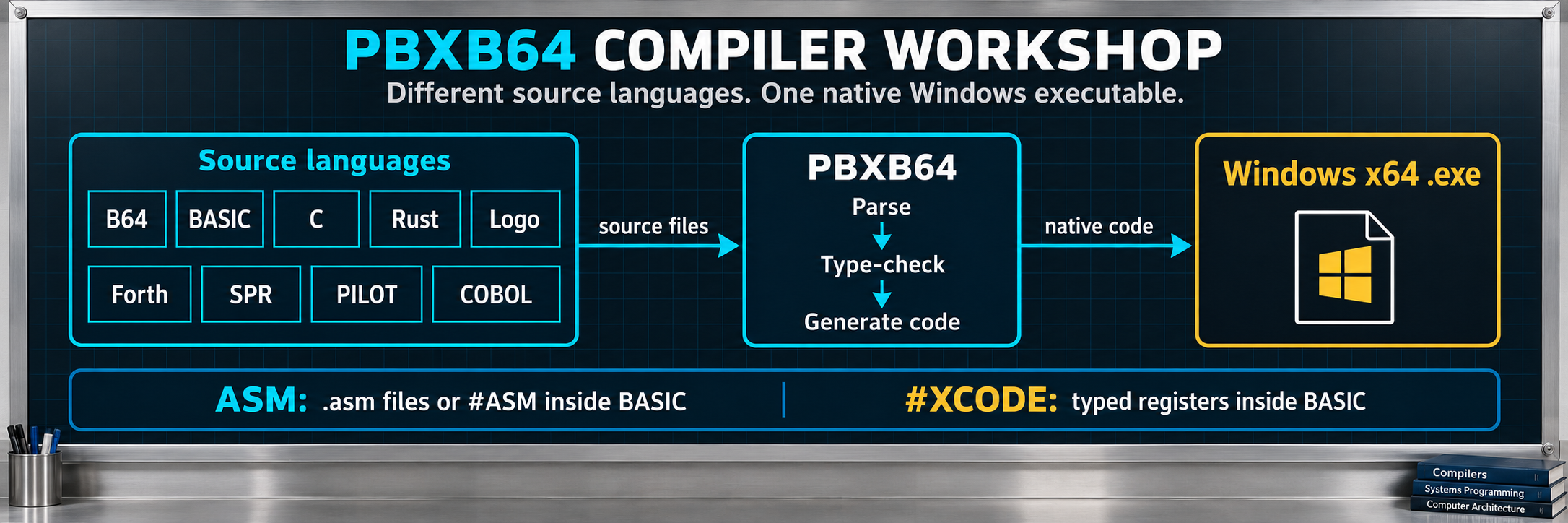
B64 uses typed variables and functions with brace-delimited blocks. These examples cover loops, parameters and an explicit loop exit.
12 short examples + larger exampleThe BASIC input combines PBMAIN, typed variables and structured statements with PBXB64 extensions. LONG is 64-bit in PBXB64.
12 short examples + larger exampleThe C input uses main and C expressions. A return value can be checked as the process exit code; printf produces output instead.
12 short examples + larger exampleThere are two workflows: #ASM blocks inside BASIC and standalone .asm source files. The first example uses a BASIC wrapper; the others use the separate ASM input.
12 short examples + larger exampleX-Code is a typed assembler dialect inside BASIC. Virtual registers describe values; the compiler assigns physical registers. Memory operations specify their width explicitly.
12 short examples + larger exampleLogo examples use named values, list blocks and clear commands. These examples focus on console computation; turtle graphics are a separate area.
12 short examples + larger exampleForth operates on a data stack. Numbers push values; words such as +, DUP and EXECUTE consume or produce them. Order is part of the program.
12 short examples + larger exampleSPR uses short command prefixes and variables such as $$SUM. These native examples combine explicit values, calculations and output.
12 short examples + larger examplePILOT uses prefixes such as C: for calculations, T: for text and J: for jumps. #names are numeric variables; $names identify strings.
12 short examples + larger exampleCOBOL separates identification, data description and execution. PIC describes data format; DISPLAY produces output and STOP RUN ends the program.
12 short examples + larger exampleThe Rust input uses fn, let and explicit types. These small examples cover loops, integer arithmetic and tuples; they are not a promise of arbitrary Cargo-project compatibility.
12 short examples + larger exampleSix source pairs: function calls, shared variables and typed bindings.
Understand bridgesEvery program calculates the sum from 1 to 5. B64, PowerBASIC, C, ASM and Rust return process exit code 15; Logo, Forth, SPR and PILOT print 15, while COBOL prints 15. X-Code is a typed assembler dialect inside a BASIC program.
Tested with the V22 candidate on 30 September 2026; publication is pending. All eleven examples were compiled and executed natively. X-Code was also checked at O0 through O3.
Detailed examples and explanation
Exit code 15
Detailed examples and explanation
Exit code 15
Detailed examples and explanation
Exit code 15
Detailed examples and explanation
The ASM quick example uses #ASM … #ENDASM inside a BASIC program. A standalone .asm file uses the separate ASM input; the X-Code page includes a jointly compiled example.
Exit code 15
Detailed examples and explanation
Exit code 15
Detailed examples and explanation
Output 15; exit code 0
Detailed examples and explanation
Output 15; exit code 0
Detailed examples and explanation
Output 15; exit code 0
Detailed examples and explanation
Output 15; exit code 0
Detailed examples and explanation
Output 15; exit code 0
Detailed examples and explanation
Exit code 15